Here is another article about people studying the ecological benefits of gophers:
http://www.nature.org/wherewework/northamerica/states/washington/misc/art24950.html'
The Nature Conservancy in Washington State is studying Mazama pocket gophers by catching them and inserting electronic tags under the critters' skin (similar to the chips used for pets). This will allow them to learn more about the range of individual gophers.
O.J. Reichman and Eric W. Seabloom have also published an article on the pocket gopher in Ecology and Evolution. (January, 2002) in which they too noted the soil-moving effects of the gopher. They observed that the gopher burrows accelerated erosion on shallow slopes and slowed erosion on steep slopes. I have not noticed increased erosion on my gently sloping land. In fact, the gopher borrows encourage the water to penetrate the soil, rather than running off. The run-off causes erosion. When the water soaks into the soil instead of running off, none of the soil is washed away.
Another article Lisa F. Cantor and Thomas G. Whitham in Ecology discusses the gopher's role in preventing aspen invasion of mountain meadows.
Grasses, incidentally, tend to benefit from root pruning by gophers (I have read this and observed it first-hand), so gopher activity would encourage prairie landscapes in regions that do not provide ideal growing conditions for trees.
This article by Jake Weltzin, Steve Archer, and Rod K. Heitschmidt looks really interesting: "Small Mammal Regulation of Vegetation Structure in a Temperate Savannah," Ecology: Vol. 78, No. 3, pp. 751-763. This article focuses on the prairie dog rather than gophers. Since prairie dogs don't live here, I don't have any first-hand knowledge of them, but they apparently eat roots and seeds and live in burrows, so their ecological niche would be similar to that of the gophers.
I think I may have to buy a few of these articles so I can read the entire articles rather than just the abstracts. Here is an excerpt from the abstract of the Weltzin, Archer, and Heitschmidt article:
These data illustrate how transitions from grassland to woodland vegetation can be mediated by a rodent herbivore. They further demonstrate how purposeful or inadvertent removal of native herbivores can have unforeseen effects on plant species composition and landscape physiognomy. Investigations of environmental constraints on vegetation distribution and abundance should take into account the historical role of herbivores in shaping the present system. Inconsistencies among historic accounts of woody plant distribution and abundance in semiarid western North America may be resolved by considering population dynamics of prairie dogs. Widespread eradication of this formerly abundant rodent has eliminated a significant constraint to woody plant establishment on many semiarid grassland and savanna landscapes and has thereby facilitated transitions to shrubland and woodland states. Past land management designed to remove one perceived impediment to livestock production appears to have contributed significantly to development of another management problem that is now a major detriment to sustainable livestock production.
Showing posts with label gophers. Show all posts
Showing posts with label gophers. Show all posts
Saturday, July 17, 2010


Pocket Gophers
The tops of the fruit trees are not the only parts of the trees that are in cages. I have to plant the trees in wire cages to keep the gopher from eating the roots of young trees down to a nub. By the time the root system is large enough to outgrow the cage, the tree is usually big and strong enough to withstand gopher nibbling.

Some people use traps or poison to kill gophers. For various reasons, I don't want to use poison, and traps seem pointless. If you kill one, another will move in. I find it's best to incorporate gophers into the landscape. Let them aerate and fertilize the soil, and prune the roots; keep them out of places where I really don't want them, such as around the roots of young trees and shrubs.

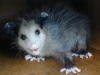
I found a dead one in the orchard today. It's too far decomposed for me to guess how it died. You can see from the photo that it was a cute, furry little thing with delicate hind feet like a rat, but it has large front feet with huge claws. Edward Scissorhands.
Most gopher discussions I've found online focus on killing by one means or another, without even trying to understand how gophers fit into the life cycle of the land as a whole. I found a couple of articles whose authors seek a more elegant and intelligent way of living with gophers.
Most gopher discussions I've found online focus on killing by one means or another, without even trying to understand how gophers fit into the life cycle of the land as a whole. I found a couple of articles whose authors seek a more elegant and intelligent way of living with gophers.
Ecological Benefits of Pocket Gophers (from Living With Wildlife - Washington Department of Fish and Wildlife)
A typical pocket gopher can move approximately a ton of soil to the surface each year. This enormous achievement reflects the gopher’s important ecological function.
Their tunnels are built and extended, then gradually fill up with soil as they are abandoned. The old nests, toilets, and partially filled pantries are buried well below the surface where the buried vegetation and droppings become deep fertilization. The soil thus becomes mellow and porous after being penetrated with burrows. Soil that has been compacted by trampling, grazing, and machinery is particularly benefited by the tunneling process.
In mountainous areas, snowmelt and rainfall are temporarily held in gopher burrows instead of running over the surface, where they are likely to cause soil erosion. [my note: even in non-mountainous areas, gopher burrows help to hold water in the soil and prevent water run-off]
Surface mounds created by gophers also bury vegetation deeper and deeper, increasing soil quality over time. In addition, fresh soil in the mounds provides a fresh seedbed for new plants, which may help to increase the variety of plants on a site.
Many mammals, large birds, and snakes eat gophers and depend on their activities to create suitable living conditions. Salamanders, toads, and other creatures seeking cool, moist conditions take refuge in unoccupied gopher burrows.[my note: I have found a couple of toads lately living in abandoned gopher burrows] Lizards use abandoned gopher burrows for quick escape cover.
Gabriel J. Miller, Steve A. Johnson, and Lora L. Smith, University of Florida, have published an article titled Ecological Engineers: Southeastern Pocket Gophers Are One of Natures Architects
The authors discuss the soil mixing benefits of gophers then move on to discuss the effects of the gophers' diet:
Root Herbivory By feeding on plant roots, Pocket Gophers can drastically affect the local plant community. Some plants can tolerate root herbivory and even flourish, but others are adversely affected. For example, grasses are known for responding favorably to root herbivory, which may be why gophers and grasses coexist together. Little is known about the effects of root herbivory on most plants, but it is likely that the root herbivory of gophers influences plant communities.http://edis.ifas.ufl.edu/uw285
Gabriel J. Miller, Steve A. Johnson, and Lora L. Smith, University of Florida, have published an article titled Ecological Engineers: Southeastern Pocket Gophers Are One of Natures Architects
The authors discuss the soil mixing benefits of gophers then move on to discuss the effects of the gophers' diet:
Root Herbivory By feeding on plant roots, Pocket Gophers can drastically affect the local plant community. Some plants can tolerate root herbivory and even flourish, but others are adversely affected. For example, grasses are known for responding favorably to root herbivory, which may be why gophers and grasses coexist together. Little is known about the effects of root herbivory on most plants, but it is likely that the root herbivory of gophers influences plant communities.http://edis.ifas.ufl.edu/uw285
It's disheartening to realize that the only advice being given to farmers and gardeners by government supported agricultural extension services, and agricultural universities is grounded in ignorance. It's true that most people who grow plants in regions where gophers live are very well aware of the effects of gophers on specific plants in the garden. But most people farm and garden in ways that make their plants vulnerable, instead of establishing communities of plants and animals that support and protect each other. I'm close to 100% sure that some things I did with my fruit trees made them attractive to the grasshoppers. I'll write more about that later.
Subscribe to:
Posts (Atom)